
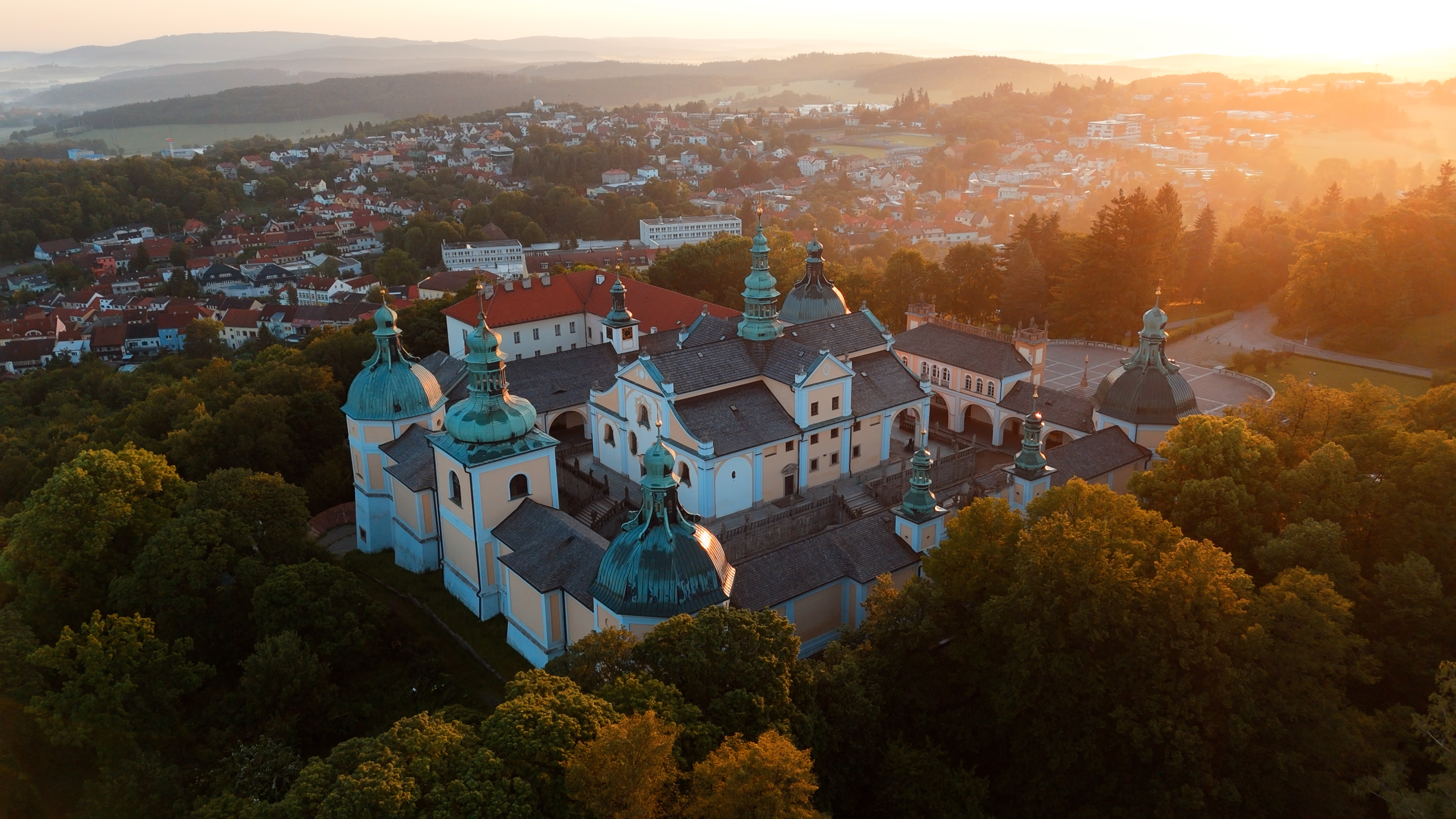
Tours
During opening hours (7 a.m. to 6 p.m.), you can see the amphitheatre and basilica for yourself.
Tours organized by travel agencies and tourist groups are obliged to register at the information centre, a guided tour of the Holy Mountain is only possible with our guide!
With a guide you will get to know Svatá Hora in an interesting and detailed way. You can choose several tours:
<details class="accordion"> <summary>REAL</summary> <p>Are you going to the Holy Mountain for the first time? A guided tour will show you the most interesting things this pilgrimage site has to offer. If you want to experience something unique, you can end the tour with an organ concert.<p>What will you see?<br> <b>Ambits</b><br> Few things are as characteristic of Svatá Hora as its ambits. They form a rectangle and were built between 1659 and 1670 to a design by the architect Carlo Lurag. They have nine arches on the north and south sides, and seven on the east and west sides. <br><b>Prague, Nunnery, Pilsen and Birch chapels</b><br> The corner of the ambyts is enclosed by octagonal chapels, roofed with a bell and lantern roof. In them you can admire, for example, rare altarpieces. And if you raise your head, you can see the most unique frescoes and stuccoes. The tour will also tell you where the names of these chapels come from. <br><b>Mary Magdalene Chapel</b><br> The real gem of the circuit is the Chapel of St Mary Magdalene. It is decorated with artificial stalactites designed to give the impression of a cave, the so-called grotto. The money for its construction was donated by General Joanes de Lacron and the stucco work was done by G. B. Cometa in 1666. The painted decoration, paintings from the life of St. Mary Magdalene, dates from 1667. <br><b>Basilica of the Assumption</b><br> The tour ends in the Basilica of the Assumption itself, in a kind of center of the whole Holy Mountain. It stands on the site of an alleged medieval church. The church is surrounded on all sides by Baroque chapels, the oldest of which is the Chapel of St Ignatius and St Francis Xavier. The most valuable work of art of the Holy Mountain is the main altar in the basilica and the love statue of Our Lady of the Holy Mountain.
</p> <p>Admission:</p> <ul> <li>Czech 150 CZK/person (full admission), 90 CZK/person (students and pensioners), 320 CZK (family admission), children under 6 years free, 6-14 years 90 CZK/person</li> <li>English/German (by prior reservation at office@farnost-svatahora.cz): 200 CZK/person (full admission), 180 CZK/person (students and pensioners)</li> <li>the tour may also include a half-hour organ concert in the Basilica of the Assumption (minimum 10 persons + 50% of the ticket price)</li> </ul> </details>
<details class="accordion"> <summary>BELLS</summary> <p>What will you see? <br><b>Bells</b><br> It is said that a church without bells is like a body without a soul. The St. Mary's ones are complemented by the famous chimes that ring out before every odd hour and before noon. Visit the bell tower and enjoy a unique view of Příbram. The belfry is housed in a low tower with a copper-covered copper roof. Eight bells are hung in the bell tower. Five of them are used for ringing. Three of the bells are non-swinging and, together with the other five, form a bell game that plays the refrain of the St. Mary's Hail Mary "Be gracious to us, O Virgin Mary, intercede for us" every odd hour, three minutes before the full hour. The bells date back to 1934 and 1935 and were made by Rudolf Perner. The largest and heaviest of the bells, called Maria, weighs 2,346 kilograms. <br><b>Duschichka chapel</b><br> The small octagonal chapel below the bell tower, called the Duschichka chapel, is dedicated to Our Lady Help of Souls in Purgatory. The paintings on the ceiling are one of the few original early Baroque paintings that still show the authorship of Christian Dittmann, despite many restoration interventions. The door to the left of the altar leads to the bell tower.
<ul><li>entrance fee: 70 CZK</li> <li>tour length: 25 min</li> <li>max number of people: 15</li> <li>steep steps must be overcome at the beginning</li> </ul> </p> </details> <details class="accordion"> <summary>SUMMARY</summary> <p>The residence was founded on a rocky slope that drops quite steeply towards the north. Historic floor levels have been discovered in the cellars beneath the rectory, which are arranged over two floors.<br> What will you see?<br><b>Residence building</b><br> The eastern basement wing of the St Mary's Jesuit residence was completed in the 1790s. The adjoining north and west wings remained only in plans. Traces of the preparations for the construction of the west wing remain only in the form of the shingles. <br><b>Basement and alterations</b><br> The residence was founded on a rocky slope that drops quite steeply towards the north. The builders respected the natural terrain, and for this reason the rooms are essentially above the natural ground level. When it became clear that the construction of the other two wings of the residence would not take place for the time being, the layout of the staircase was changed. <br><b>Singers' underground bedroom</b><br> The first room in the semi-basement (now the concert hall) was intended to be the musicians' and singers' bedroom, as evidenced by the missing tiles where the stove was located. Of the whole floor, only this room was to have had a stove (see plan). Also the window openings, now blocked up, originally lit the room well. <br><b>The foundations of the earlier building have been discovered</b><br> In the middle room various recesses can be seen in the walls, probably from various alterations and watering. This is where the entrance from the outside to the musicians' bedroom was originally planned so as not to disturb the boys. Structures were found under the floor of this room indicating an earlier structure built before the residence was built. <br><b>Black Kitchen</b><br> The stairs, now leading to the walled entrance alcove from the semi-basement (2nd basement floor), formerly led to the former "black kitchen", which now serves as a lecture room. The now walled entrance was used to bring foodstuffs down to the cellar, but also to take ash from the fireplace, which was poured into one of the unused spaces in the western part of the 1st floor of the cellar. However, the original plans of the Jesuits called for a grand staircase up to the upper floor of the residence. <br><b>Stools</b><br> A sump was discovered under the basement floor of the original Jesuit residence, which was part of the historic water system. <ul><li>admission: 70 CZK</li><li>tour length: 25 min</li><li>max number of persons: 30</li></ul> </p> </details> <details class="accordion"> <summary>Clock Tower</summary> <p>The clock tower machine in the exceptionally accessible clock tower area in the truss of the northern ambyte is a bit of a climbing challenge too.<br> What will you see?<br> <b>The Clock</b><br> You can take a tour of the clock tower with the restored tower clock exclusively with the expert commentary of the restorer Jiří Češka, who repaired and restored the machine.<br> <b>Views</b><br> Through the windows in the dials you can see Příbram from a bird's eye view. <ul> <li>admission fee: 120 CZK</li> <li>tour length: 25 min</li> <li>max. 12 persons</li> <li>the tour is physically demanding and involves passing through confined spaces</li> </li> </ul> </p> </details> <details class="accordion"> <summary>UPPER WALK AND RESIDENCE</summary> <p>High vaults and ornate ceilings. The Bishop's Room with inlaid floor and many fine pieces of period furnishings.<br> What will you see?<br> <b>Upper Corridor</b><br> During this tour you will have the opportunity to hear the ticking of the newly restored Baroque floor clock in the so-called Bishop's Room. At the same time, you can see the upper corridor of the presbytery itself, decorated with a number of portraits of personalities important for the history of the Holy Mountain.<br> <b>The Treasury</b><br> If you decide to join the tour of the Upper Corridor with a tour of the Treasury, you will also see an exhibition of reliquaries and relics. Even the Czech king and Roman emperor Charles IV had a passion for collecting the relics of saints. The tradition of venerating so-called relics is still alive today. <ul><li>admission 70 CZK</li> <li>tour length 20 min</li> <li>max number of persons: 30</li> </ul> </p> </details> To make this a truly inclusive place, please observe the following rules: turn off your cell phones, do not bring pets into the area (even in portable crates), do not smoke (including electronic cigarettes), do not consume food or beverages, do not talk loudly, do not run, and do not enter with bicycles or scooters.